Districts are being asked to make increasingly complex decisions about computer science, AI, curriculum, instruction, and access. Those decisions are not only about choosing the right tools or programs. They shape who gets opportunities, how educators are supported, and whether new initiatives become part of a school system in ways that are thoughtful, inclusive, and sustainable.
For years, BootUp has worked alongside school districts to build computer science pathways across schools. We have seen skilled coaches and leaders help teachers move from uncertainty to confidence, adapt new learning to their own classrooms, and continue growing after a professional learning session ends. Emerging research in computer science education suggests that coaching may support the development of equity-focused teaching practices. In a 2024 pilot study, Rosato et al. found that individualized CS coaching was associated with changes in how participating teachers approached classroom practice. Teachers described becoming more intentional about student grouping and participation, examining possible bias in their instruction, and adjusting teaching strategies to better fit the learners in front of them. The study also suggests that coaching may complement initial professional learning by giving teachers continued, context-specific support as they refine their practice (Rosato et al., 2024).
We have also seen that these skills are valuable far beyond formal coaching roles. The ability to build trust, develop others, and guide implementation is important wherever leadership happens in a school or district. As computer science and AI become a larger part of K–8 education, districts need people who can lead this work with both instructional skill and an equity lens. Knowing the content matters, but so does understanding how decisions about curriculum, access, and implementation can affect students and educators differently.
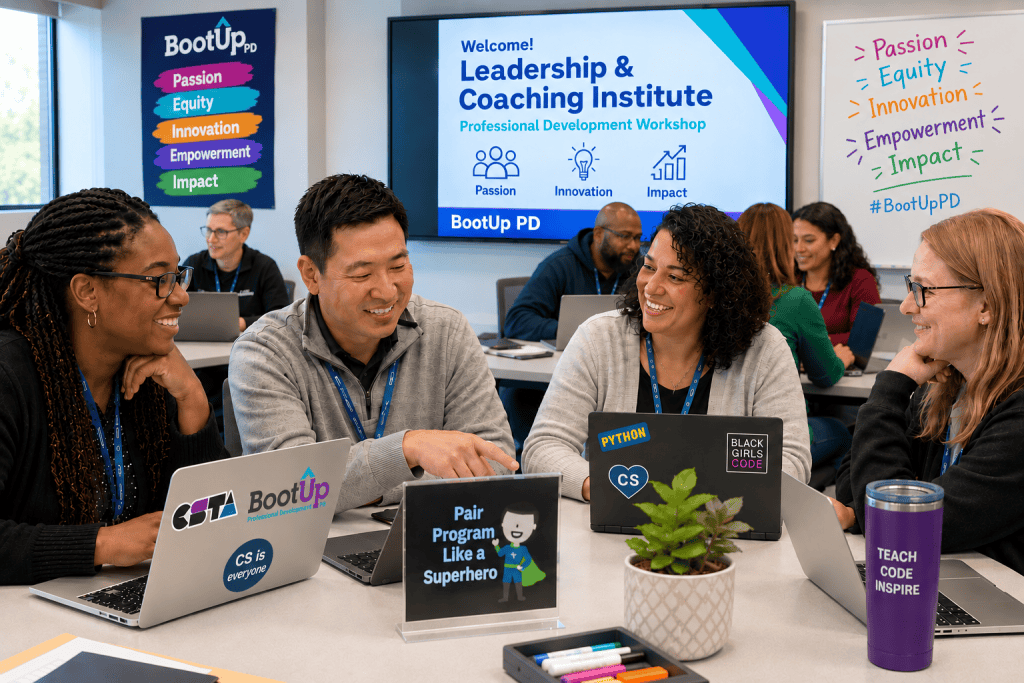
That is why we created the BootUp Leadership and Coaching Institute. The program was developed, and will be facilitated, by leaders with deep expertise in instructional coaching, K–8 computer science education, curriculum, and equity. Bringing these areas of expertise together allows participants to learn from people who understand what it takes to support educators, strengthen instruction, and expand access in real schools and systems.
The Institute is designed for educators and leaders across roles. The goal is not to create one model of leadership, but to help participants strengthen the skills they need to support others, facilitate professional learning, build trust, and help good ideas become stronger practice within their own setting. This kind of work also requires leaders to look beyond overall outcomes and examine patterns within their own schools and districts. Soria and Ginsberg (2016), for example, describe how an equity audit helped educators examine student data and investigate less-visible factors contributing to inequitable outcomes for English learners. Their work illustrates how structured examination of data and school practices can provide educators with questions to investigate and act upon. Similarly, Johnson (2020) describes equity audits as a way for educators and school leaders to analyze policies, practices, and data in order to identify opportunity gaps across education. Together, these examples highlight the value of developing leaders who can ask critical questions about who is being served, who may be experiencing barriers, and what changes may be needed.
At the center of BootUp's approach is a simple idea: access alone is not enough. The people leading and supporting implementation play an important role in whether opportunities become meaningful, equitable, and sustainable. Technology provides a useful example. Having technology available does not necessarily mean every student can participate in the learning it makes possible. A review of research on technology accessibility in K–12 schools found that inaccessible technologies can deny students with disabilities equal access to technology-enhanced learning opportunities. Shaheen and Lohnes Watulak (2019) highlight that technology access is incomplete when some learners still encounter barriers to participation, making accessibility an important consideration in school technology decisions.
The same principle applies more broadly to computer science and AI. Schools need to look beyond whether an opportunity exists and pay attention to who is benefiting, what students experience once they participate, and where barriers may remain.
The BootUp Leadership and Coaching Institute prepares participants to examine implementation through the lenses of access, belonging, bias, instructional quality, educator capacity, and systemic change. Rather than treating equity as something separate from implementation, participants consider how decisions about teaching, support, and opportunity affect the people they serve.
At BootUp, we approach culturally responsive leadership as a practice of paying attention to context. That means understanding the communities educators serve, making space for perspectives that may otherwise be overlooked, and avoiding one-size-fits-all approaches to implementation. We also recognize that students and educators bring multiple, overlapping experiences and identities with them into schools. The Institute gives participants space to consider how those realities shape access, belonging, participation, and the decisions they make as leaders.
For districts, this is ultimately an investment in internal capacity. Curriculum, technology, and professional learning all matter, but people determine how those resources reach classrooms and students. Developing educators who know how to support colleagues, recognize barriers, and guide implementation gives a district leadership capacity that can extend well beyond a single initiative.
The Leadership and Coaching Institute is designed to help districts build that capacity by investing in the people who will carry the work forward.
Johnson, P. N. (2020). Using equity audits to assess and address opportunity gaps across education. IDRA Newsletter, 47(4).
Rosato, J., Thigpen, L., Brunson, F., Tise, J. C., & McGill, M. M. (2024). Coaching teachers to teach computer science with equity-focused teacher standards. Proceedings of the 19th WiPSCE Conference on Primary and Secondary Computing Education Research.
Shaheen, N. L., & Lohnes Watulak, S. (2019). Bringing disability into the discussion: Examining technology accessibility as an equity concern in the field of instructional technology. Journal of Research on Technology in Education, 51(2), 187–201.
Soria, L. R., & Ginsberg, M. B. (2016). Questions that lead to action: Equity audits motivate teachers to focus on English learners’ needs. Journal of Staff Development, 37(5).